
Introducing the AI Warfare Library
120 Books That Map the Most Important Shift in Human Conflict

Something fundamental changed in how wars are fought and most people missed it.
Not because the information wasn’t there. Because there was too much of it, scattered across too many books, written by too many people from too many different angles — soldiers, philosophers, engineers, lawyers, journalists, spies.
The AI warfare literature is vast, fragmented, and largely unnavigable if you don’t already know where to look.
I've spent the last few years watching AI move from boardrooms to battlefields and noticed that most of the people making decisions in both spaces hadn't read the same books. Soldiers who hadn't read the technologists. Technologists who hadn't read the strategists. Strategists who hadn't read the ethicists. Everyone was working from an incomplete picture. I built this library because the map didn't exist and somebody needed to make it.
So I built a map
What the AI Warfare Library is
Why Six Scores
What’s inside
How it publishes
Who is this for
What the AI Warfare Library is
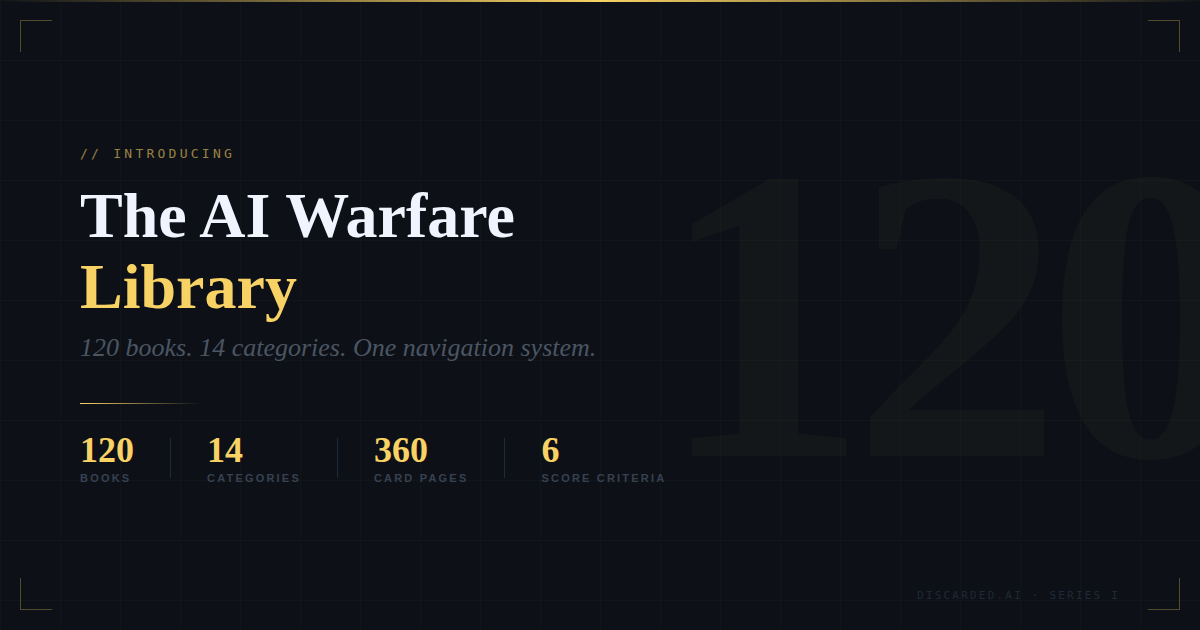
120 books. Every significant work on autonomous weapons, drone warfare, cyber operations, great power competition, AI safety, and the ethics of machine-speed conflict — curated, scored, annotated, and connected to each other.
Not a reading list. A navigation system.
The difference matters. A reading list tells you what exists. A navigation system tells you where to start, how deep to go, what connects to what, and which books are essential versus which are interesting. This library does all of that.
Each book gets a three-page card.
Page 1 — The Card. Visual identity, author credentials, and six scores. Scannable in seconds. Designed to be shared as a standalone image. One glance tells you what the book is, who wrote it, and how it ranks against everything else in the library.
Page 2 — The Brief. The book’s core argument in one paragraph. Four things you will concretely learn. And exactly how it connects to four other books in the library. Objective. No opinion. Pure reference — designed so that reading five Page 2s on the same topic gives you a complete briefing on that subject from multiple angles.
Page 3 — The Take. The historical moment the book was written into. The events it anticipated and the ones it missed. And my honest assessment — what the argument got right, what reality has since overtaken, and who needs to read it right now.
Why six scores
Most recommendations tell you a book is good. These scores tell you how to use it.
Every book in the library is rated across six criteria on a scale of 1 to 10.
Readability — how accessible is this to a non-specialist? Highest score means start here. Lowest means you need to build up to it.
Influence — what impact has this had on doctrine, policy, and the field? Highest score means this is what everyone else is arguing with. It’s the text you need to understand the conversation.
Authenticity — does the author have standing to write this? There is a significant difference between a former Army Ranger turned Pentagon policy official and an Oxford philosopher theorising from the outside. This score makes that visible.
Originality — did the author say something nobody had said before? Did they coin a framework the field now uses? Or are they synthesising existing ideas competently?
Provocation — does reading this force you to reconsider a position you hold? The highest scoring books here are the ones that challenge assumptions you didn’t know you had.
Relevance — how connected is this to what is happening right now? A book written in 2018 that anticipated Ukraine scores differently to one that didn’t, regardless of when it was published.
Filter by topic. Use the scores to decide what to read first, what to read deep, and what you can skip.
What’s inside
14 categories covering the complete terrain of AI-enabled conflict:
Essential Canon — the 10 books every other book in this library argues with. Start here.
Drone Warfare — from the first Predator deployment to Ukraine swarm warfare. The full arc.
Autonomous Systems & Automation — how automation works, how it fails, what happens when machines make kill decisions at speed.
Great Power Competition — the US-China-Russia AI arms race at the strategic level. Who is winning, what they are building, what the balance of power actually looks like.
Cyber Warfare — Stuxnet, Sandworm, Volt Typhoon. The technical layer of AI-enabled conflict.
Information & Cognitive Warfare — disinformation, algorithmic amplification, influence operations. The layer above the technical.
Intelligence & Surveillance — ISR, targeting systems, algorithmic surveillance. How AI changes the see-decide-act cycle.
AI Safety & Ethics — alignment, accountability, legal frameworks. The normative debate about what these systems should and should not do.
Strategy & Doctrine — how militaries think, plan, and adapt. Classical strategy reinterpreted for the AI era.
Geopolitics & Economics — semiconductor supply chains, industrial base, the political economy of AI power. Who controls the hardware controls the war.
Live Conflicts — Ukraine, Gaza, Nagorno-Karabakh as real-time case studies. The empirical ground truth for every theoretical claim in the library.
Fiction & Foresight — the writers who imagined this future before it arrived. Which ones got it right.
History & Origins — how we arrived at this moment. The long arc from early computing to autonomous weapons.
Policy & Law — treaties, governance frameworks, accountability mechanisms. The institutional response to AI-enabled conflict.
How it publishes
One category per week. Every Tuesday.
Each drop covers a complete category — 8 to 12 books published together so you can immediately see how the ideas connect, where they agree, and where they argue. Reading a full category drop is the equivalent of a structured briefing on that subject.
14 weeks. 14 categories. 120 books.
When the series is complete, the entire library — all 360 card pages — will be available as a single downloadable PDF for paid subscribers. Every book, every score, every connection, in one document.
The first category drops next Tuesday: The Essential Canon. The 10 books that defined the field. The texts that every soldier, strategist, technologist, and policymaker working in this space needs to have encountered.
Who this is for
If you work in AI, defence, policy, intelligence, technology, or geopolitics — and you want a working map of the intellectual terrain where these fields are colliding — this library is built for you.
You don’t need to read all 120 books. You need to know what they argue, how they connect, and which ones matter most for the questions you’re actually facing right now.
War is moving faster than the institutions governing it. The frameworks being built today — in think tanks, in Pentagon corridors, in Chinese military academies, in UN conference rooms — are being built by people who have read these books.
You should know what they know.
Subscribe to the AI Warfare Library section to get each category drop every Tuesday. The complete library PDF will be available to paid subscribers when the series is complete.
Already live: [Army of None — Paul Scharre → ]
